Professional Volkswagen Shock Absorber Replacement
Suspension Repair Dubai offers expert Volkswagen shock absorber replacement. We service hydraulic, gas-charged, and DCC adaptive systems using OEM-grade parts and precision calibration to restore ride comfort and chassis stability.
Why Choose Us for Volkswagen Shock Absorber Replacement?
Maintaining the smooth handling and signature comfort of a Volkswagen requires specialized technical skill. Our experts combine manufacturer-level knowledge with advanced tools and high-quality parts to restore the precise driving dynamics that define your vehicle.
Here is why Volkswagen owners in Dubai trust our team:
Certified Volkswagen Suspension Specialists
Our technicians are highly trained in European suspension architectures and possess deep experience with all Volkswagen platforms, including the complex DCC adaptive damping found in the Golf GTI, Passat, and Tiguan. Every service is executed with strict adherence to factory protocols to ensure optimal safety and performance.
Genuine OEM and Premium Aftermarket Parts
We exclusively utilize OEM-grade components or top-tier aftermarket solutions from trusted brands like Sachs and Bilstein. These parts are engineered to meet or exceed Volkswagen’s original damping requirements, ensuring your car maintains its stability, comfort, and reliable road control for years to come.
Advanced Diagnostic and Calibration Equipment
Modern Volkswagen suspension systems, especially those using DCC, demand precise computerized recalibration after components are replaced. We utilize factory-aligned diagnostic software and laser-guided systems to reset your suspension geometry, ensuring damping forces return to their exact intended manufacturer specifications.
Transparent Pricing and Honest Evaluation
Before we start any maintenance, our team conducts a thorough inspection to identify all affected suspension components. You receive a clear, itemized report explaining the necessary repairs, recommended parts, and total costs, ensuring complete transparency without hidden fees or forced add-ons.
Comprehensive Suspension Care with Service Warranty
Our service extends beyond just the shock absorbers; we also evaluate your struts, sway bar links, control arm bushings, and coil springs. Every repair is backed by a solid service warranty covering both parts and labor, offering you long-term peace of mind and consistent driving quality.
Shock Absorber Repair and Replacement Services We Provide
Our experts offer 6 specialized shock absorber solutions tailored to every Volkswagen model operating across the diverse roads of Dubai:
Standard Shock Absorber Replacement
Precise removal and installation of hydraulic and gas-charged units for Volkswagen Polo, Golf, and Jetta models, ensuring every part meets strict OEM-grade performance standards.
Dynamic Chassis Control (DCC) Shock Replacement
Expert replacement of complex DCC units for performance-oriented models like the Golf R, Arteon, and Tiguan, complete with full electronic system calibration and sensor resetting.
Shock Absorber Leak Inspection and Seal Diagnosis
Detailed investigation of your vehicle’s hydraulic systems, focusing on fluid leak detection and internal seal health to stop damping performance loss before it worsens.
Suspension Geometry and Wheel Alignment
Essential four-wheel laser alignment conducted after every service to perfectly restore factory suspension geometry and eliminate uneven tire wear or "scrubbing" issues.
Full Suspension System Inspection
A deep-dive analysis of your entire undercarriage, covering struts, coil springs, control arm bushings, sway bar links, and shock mounts to ensure holistic vehicle health.
Post-Replacement Road Testing and Calibration
Systematic computerized damping verification combined with real-world road testing to guarantee that your vehicle’s handling, ride balance, and steering precision meet factory safety benchmarks.
How to Know If Your Volkswagen Shock Absorbers Need Professional Replacement?
Worn shock absorbers generate distinct physical signs that impact your car’s ride quality, road handling, and general safety. Detecting these indicators early prevents secondary damage to expensive components like your tires, struts, and control arms.
Bouncy Ride
If your Volkswagen continues to bounce multiple times after driving over a speed bump instead of leveling out, your internal hydraulic damping has clearly failed.
Fluid Leaks
Inspecting your shock bodies for signs of oil or dampness is vital, as leaking fluid indicates broken internal seals that stop the unit from managing suspension movement.
Uneven Tire Wear
When shocks can no longer hold the tire firmly against the road, you may notice irregular patterns like “cupping,” which serves as a signal to replace your dampers and protect your tire investment.
Nose-Diving or Squatting
If the front of your car dips excessively when you brake or the back drops during quick acceleration, the shocks are failing to control weight transfer across the chassis.
Strange Noises
Clicking, knocking, or squeaking sounds heard over uneven pavement usually point toward collapsed shock mounts, aged bushings, or mechanical failures inside the damping unit itself.
Longer Braking Distance
Compromised dampers reduce tire-to-road friction, which increases your stopping distance; research confirms that worn units can force your car to require 20% more room to come to a full stop.
Major Causes of Shock Absorber Damage
Volkswagen builds its vehicles to survive tough conditions, but even the best suspension parts suffer from normal wear, heavy use, and the local climate.
- Age and Mileage: Under normal conditions, Volkswagen shocks usually perform well until the 80,000 to 120,000-kilometer mark, though this varies based on your specific driving habits.
- Harsh Road Conditions: Frequent travel over potholes, speed bumps, and rough, uneven asphalt puts immense strain on your suspension, necessitating more frequent check-ups to ensure durability.
- Overloading or Towing: Exceeding your vehicle’s recommended weight capacity causes dangerous pressure on your shock absorbers, springs, and struts, which accelerates the wear process significantly.
- Corrosion and Heat: Dubai’s intense heat and high humidity levels can degrade protective coatings and seals on shock bodies, making regular inspections vital for long-term preventive care.
- Seal Degradation: Over the course of many years, the internal rubber seals lose their elasticity and start to leak hydraulic fluid, which is the primary cause of sudden damping loss.
- Irregular Maintenance: Ignoring small warning signs or skipping scheduled suspension check-ups allows minor issues to turn into complete component failure that could have been avoided with prompt service.
Types of Shock Absorbers We Used in Volkswagen Vehicles
Volkswagen integrates multiple shock absorber technologies across its vehicle lineup, each matched to the model's performance tier and suspension architecture.
Hydraulic (Oil-Filled) Shocks
Use pressurized oil to resist and absorb suspension movement. These are found in base suspension configurations, delivering consistent performance for daily urban driving.
Gas-Charged Shocks
Use a nitrogen gas chamber alongside hydraulic oil to prevent fluid foaming during rapid damping cycles. These units provide quicker response times and improved handling on mixed road surfaces.
Dynamic Chassis Control (DCC) Shocks
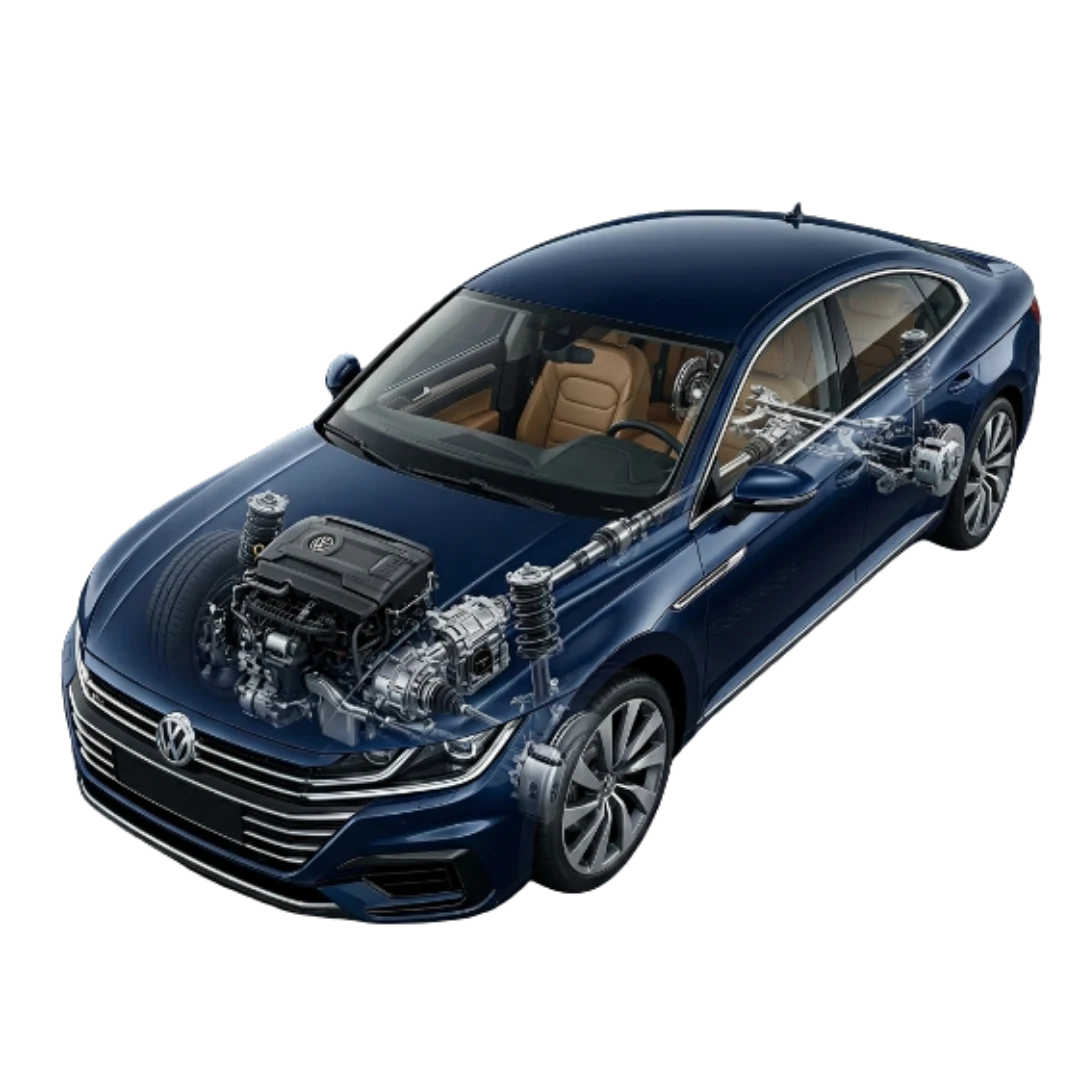
Volkswagen’s adaptive damping system that adjusts damping force in milliseconds. Models equipped with DCC include the Golf R and Arteon. Replacement requires specialized electronic calibration tools.
Benefits of Replacing Worn Shock Absorbers
Replacing deteriorated shock absorbers on a Volkswagen delivers measurable improvements:
Eliminates body bounce and vibration, restoring the refined, controlled ride Volkswagen is known for.
Maintains proper tire contact during cornering, reducing body roll and improving driver confidence.
Consistent tire-to-road contact shortens braking distances and improves vehicle stability during emergency stops.
A balanced suspension system ensures equal pressure distribution, preventing premature tread wear and extending tire life by up to 30%.
Volkswagen Shock Absorber Replacement Process (Step-by-Step)
The system is fully examined for leaks, corrosion, and physical damage.
The Volkswagen is raised securely on a hydraulic lift for undercarriage access.
Wheels are removed to allow access to mounting points.
Upper and lower bolts are loosened using calibrated torque tools.
The worn unit is extracted carefully.
OEM or equivalent shocks are installed and torqued to manufacturer specifications.
Wheels are reinstalled, and fasteners are inspected.
A four-wheel alignment is performed, followed by a road test to confirm damping response and stability.
Maintenance Tips After Shock Absorber Replacement
Replacing shock absorbers is a key step in preserving Cadillac suspension performance. Following a structured maintenance routine after replacement extends service life and prevents premature wear.
Inspect the suspension every 10,000 to 15,000 kilometers.
Proper pressure supports new shock absorbers and enhances comfort.
Adhere to the vehicle’s payload capacity to prevent suspension strain.
Ensures even load distribution and prevents irregular tire wear.
Rinse away sand and road debris to prevent corrosion buildup.
Volkswagen Shock Absorber Replacement Cost – Key Factors
| Cost Factor | Description |
|---|---|
| Model and Year | High-performance models with DCC systems cost more to service due to complexity. |
| Shock Absorber Type | Adaptive DCC units carry higher parts costs than standard hydraulic dampers. |
| Front or Rear Replacement | Front replacements often involve more labor due to steering component proximity. |
| Labor Rates | Depends on certification level and use of specialized calibration equipment. |
| Additional Repairs | Worn mounts or bushings identified during inspection may increase the scope of work. |
| Parts Quality | OEM parts ensure longer service life and factory-spec performance. |
Why Professional Replacement Matters?
Volkswagen suspension systems are electronically integrated with stability and traction control modules. Using proper calibration equipment ensures the control module receives accurate sensor data, preventing warning lights and maintaining safety. A professional replacement restores your vehicle to factory standards.
Frequently Asked Questions
How do I know if my Volkswagen's shock absorbers need replacement?
Signs include excessive bouncing, visible oil leaks, uneven tire wear, nose-diving during braking, and knocking noises over bumps. If you notice your car feeling less stable than usual on corners, it is a clear indicator that the damping efficiency has dropped.
How often should shock absorbers be replaced in a Volkswagen?
Typically between 80,000 and 120,000 kilometers. We recommend inspections every 15,000 kilometers in Dubai because our local heat and road conditions can accelerate the degradation of internal seals.
What happens if I drive my Volkswagen with bad shock absorbers?
It increases braking distance, reduces handling precision, and accelerates wear on tires and steering components. Continuing to drive in this state puts unnecessary stress on your vehicle’s suspension geometry, leading to more expensive repairs later.
Are Volkswagen shock absorbers the same as struts?
No. Struts are structural load-bearing components, while shock absorbers primarily control damping. Many Volkswagens use a mix of both systems to provide that signature balanced driving feel.
Do Volkswagen vehicles have adaptive suspension?
Yes, many models use Dynamic Chassis Control (DCC) to adjust damping automatically. This advanced system monitors road conditions in real-time to ensure the vehicle remains comfortable while maintaining a sporty response.
Can I replace Volkswagen shock absorbers with aftermarket options?
Yes, premium brands like Bilstein and Sachs are excellent, provided they match factory specifications. These aftermarket solutions often offer a great balance between cost and performance for daily drivers.
How long does a Volkswagen shock absorber replacement take?
Standard replacement takes 2 to 3 hours; DCC-equipped models may take 3 to 5 hours due to calibration. Our technicians prioritize accuracy during this time to ensure your vehicle’s electronic systems are perfectly synced.
What causes Volkswagen shock absorbers to wear out quickly?
Rough roads, overloading, heat exposure, and lack of alignment are primary causes. Regular professional check-ups help identify these factors before they result in a complete failure of the damping unit.
Should I replace all four shocks of the Volkswagen at once?
We recommend replacing them in axle pairs to maintain balanced handling. Replacing them in pairs ensures that the left and right sides of your vehicle respond identically to road irregularities.
Does my Volkswagen need an alignment after replacing my shock absorbers?
Yes, a four-wheel alignment is mandatory to maintain suspension geometry and tire health. Failing to perform this step can lead to rapid, uneven tire wear and a pull in your steering wheel while driving.